Our History
Our History
The Sew-Lesew Elders and Child Support Organization began its compassionate journey in the Ethiopian calendar year 2010 (corresponding to 2017/2018 G.C.) in Jimma, Ethiopia. Born from the profound dedication of a volunteer family, the initiative started modestly within their private residence, utilizing six available rooms to provide immediate care. Its initial beneficiaries included a single infant, Yohannes, and five elderly individuals, one of whom was suffering from mental illness.
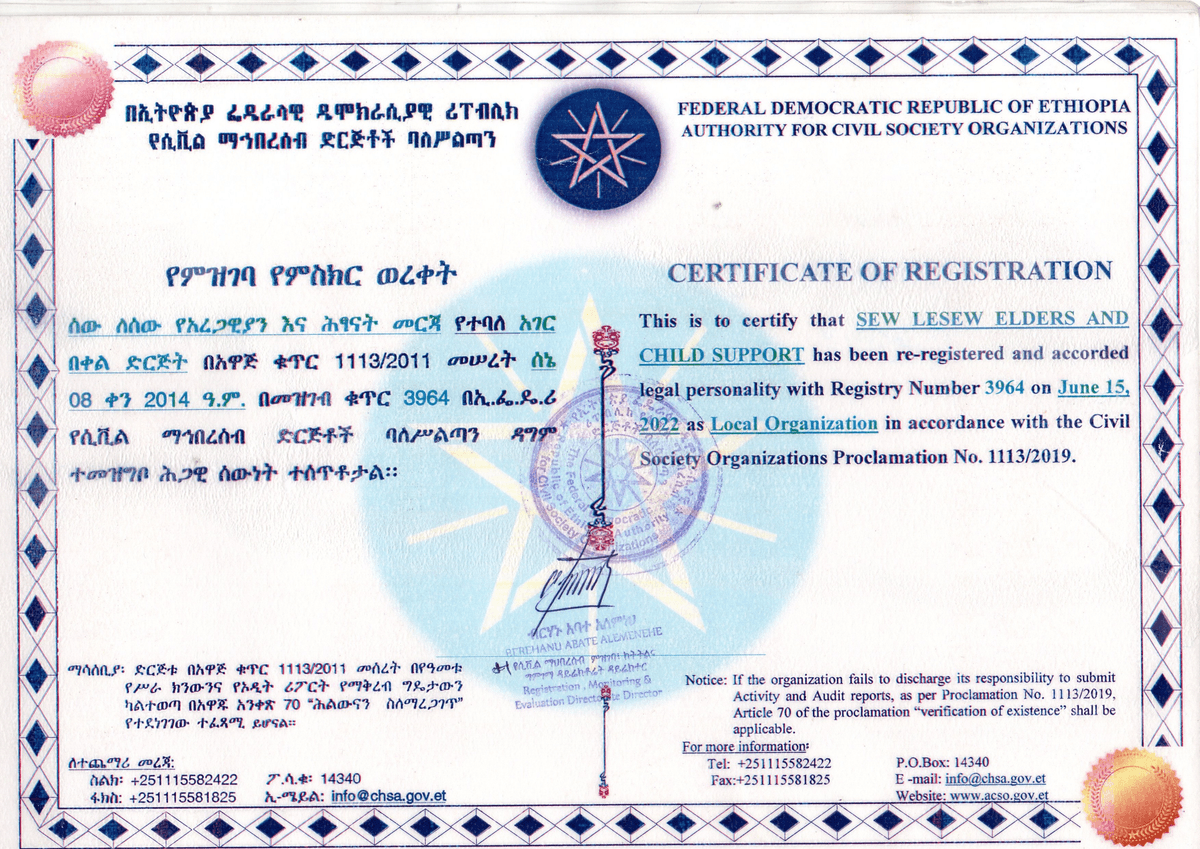
Recognizing the need for a structured and legally recognized framework, the organization swiftly moved to formalize its operations. On June 11, 2010 E.C. (2018 G.C.), it was officially registered as a charitable organization under Ethiopian Proclamation No. 621, Article 661, obtaining certificate number 3964.
Since its inception, Sew-Lesew has pursued a strategic roadmap with short-, medium-, and long-term programs focused on establishing infrastructure, growing membership, and fundraising. This has led to significant impact, aiding over 200 vulnerable individuals through education and adoptive homes for children, and dignified care for elderly and mentally ill beneficiaries—with strong support from partners like Jimma University, local clinics, and government entities.
Our Vision
The Sew-Lesew Elders and Child Support Organization envisions a future where the elderly are healthy and self-sufficient, and children are raised with love, care, and strong morals to become contributing members of society.
What We Do
We provide comprehensive social and humanitarian services that transform the lives of vulnerable elders, children, and mentally ill individuals in Jimma and across Southwest Ethiopia. We gather and provide a safe, nurturing environment; ensure access to food, clean water, shelter, and clothing; facilitate education for children; offer compassionate care for the elderly and mentally ill; engage elders in rehabilitative activities; and coordinate with local clinics and hospitals for essential healthcare.